
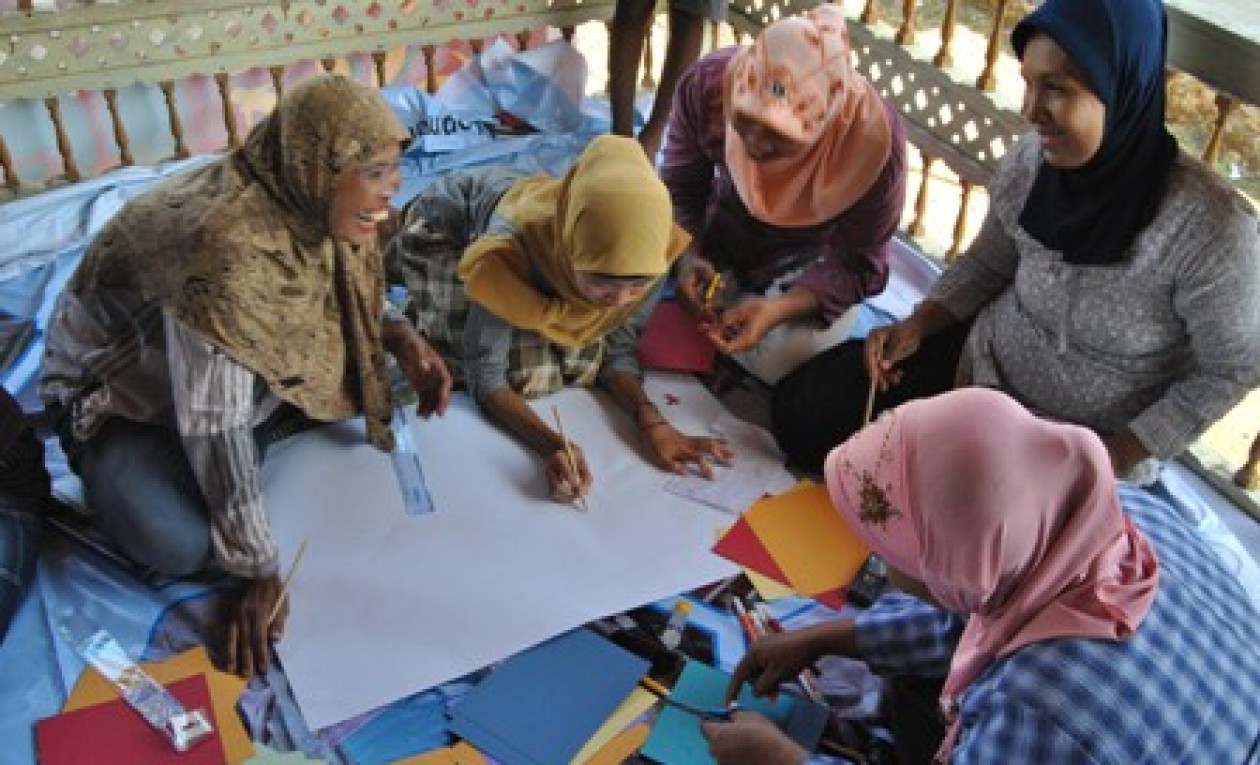

Three years ago, Muslimah was not the woman she is now, she was a housewife who struggled daily with household affairs and helped her husband. Now, after leading a women’s group in the village of Lampoko, Muslimah has become a woman who is courageous and ready to fight for the interests of coastal women through political channels. See how the story unfolds!
Starting off as a duck breeder
The arrival of Oxfam’s partners who introduced the Coastal Livelihood Restoration program to the women in the village of Lampoko in 2010 seemed to be the turning point for the transformation that has occurred to Muslimah today. At that time, the Nusantara Maritime Institution (LEMSA), one of Oxfam’s partners who implemented the program, held meetings with the community. From the discussions, the women agreed to form a duck breeding group as a forum to strengthen the economic development of the village. They then agreed to form a group called the Pakkiti Group, which means duck breeding. And, Muslimah was appointed chairman of the group that consisted of 21 women.
“In the past, no one in the village knew me. I was just a simple housewife. Apart from that, I was a newcomer and moved to this village because I got married and followed my husband here,” said Muslimah reliving her past.
The tradition in the village of Lampoko indeed restricts women’s mobility. Most of them spend their time under the house to mingle with neighbors or other family members. In this village, the houses are generally built on stilts. The houses here are constructed one and a half to two meters above ground. The space under the houses is commonly used as a lounge or a place to welcome guests or neighbors who visit.
“The conditions changed when LEMSA came to our village and we were included in an Field School Program. I signed up as a participant in this school. There, we obtained a variety of training including how to grow organic crops. One of the benefits of the Field School activities is the motivation delivered by the partners as well as the Oxfam team that enabled us to attain the ability to express our opinions”, continued Muslimah. “Having completed the Field School activities, we then tried to raise ducks with limited capital. The results of our efforts were not necessarily immediate. Our capital was small, and as a consequence, the business developed at a slow rate.”
In view of these conditions, Oxfam then distributed 208 ducks to the Pakkiti Group. With the capital received, the group then pursued this activity energetically. They also received training on cultivation techniques, business management, including marketing. The Pakkiti group then developed a salted egg business in their efforts to earn income for their households.

Invited to Speak
Although there is no tradition that restricts women from speaking, limited mobility and knowledge of women are causes of their low self-confidence. Women spend more time at home taking care of the family. The non-family related activities conducted by women are only attending weddings and as seasonal workers during the rice harvest in the neighboring village.
“Eight months after the distribution, the ducks that we reared have started laying eggs. In the group, we had decided to process the eggs into salted eggs and sell them in the stalls around the village as well as to the neighboring villages,” said Muslimah. When marketing the salted eggs, members of the Patiti group, including Muslimah had the opportunity to negotiate prices with the traders and shops. The women’s ability to communicate with others is further sharpened.
Aware of the capabilities of women, the village government finally invited them in development planning meetings. “The ability and experience that we gained has resulted in our being invited to the Musrenbang (Development Planning Discussions) meetings in the village,” added Muslimah.
The courage and self-confidence of the women members of the Pakkiti group has also become the main asset in obtaining additional funds for production activities. In 2012, Muslimah and members of the group met with Semen Tonasa (a cement manufacturing company) and submitted a proposal requesting for additional working capital to breed ducks. Three months thereafter, Semen Tonasa granted a Rp 33 million worth of aid to three members of the group. “We proposed that the aid be given to the group. But according to the people at Semen Tonasa, our group is not yet able to manage the funds as a group because it should first have a strong administration system. Nonetheless, we were content because the funds can still be utilized by the group although it was granted to individuals. The next year, we endeavored to enable our group to become qualified and fulfill the requirements of Semen Tonasa to receive the assistance,” Muslimah said.
Becoming a candidate member of the District Council
In view of the courage and capabilities of Muslimah, a local party recruited her to become a candidate member of the regional legislative council for the 2014 elections. The need to fulfill the quota of women’s representation up to 30 percent in the house of representatives at the central as well as the regional level has compelled political parties in Indonesia to secure more women legislative candidates, and the ability possessed by Muslimah is considered more than adequate to appoint her as one of those candidates.
“I am just a graduate of a senior high school for economics (SMEA). I only learned accounting. I am not hoping for much. If I am not elected, this will not be a problem for me. More importantly, I have gained new experiences,” she said.
“But, if I am elected, I will fight for women in the coastal villages so that they may have a livelihood. In addition, I will fight for more and more women to become involved in development planning. Not only should highly educated members of the community be involved, women also need to be included in order to gain experience …” she said with excitement.
This blog is written by Aloysius Suratin, Deputy Country Director Oxfam in Indonesia
Source : http://www.oxfamblogs.org/asia/i-will-fight-for-coastal-women/